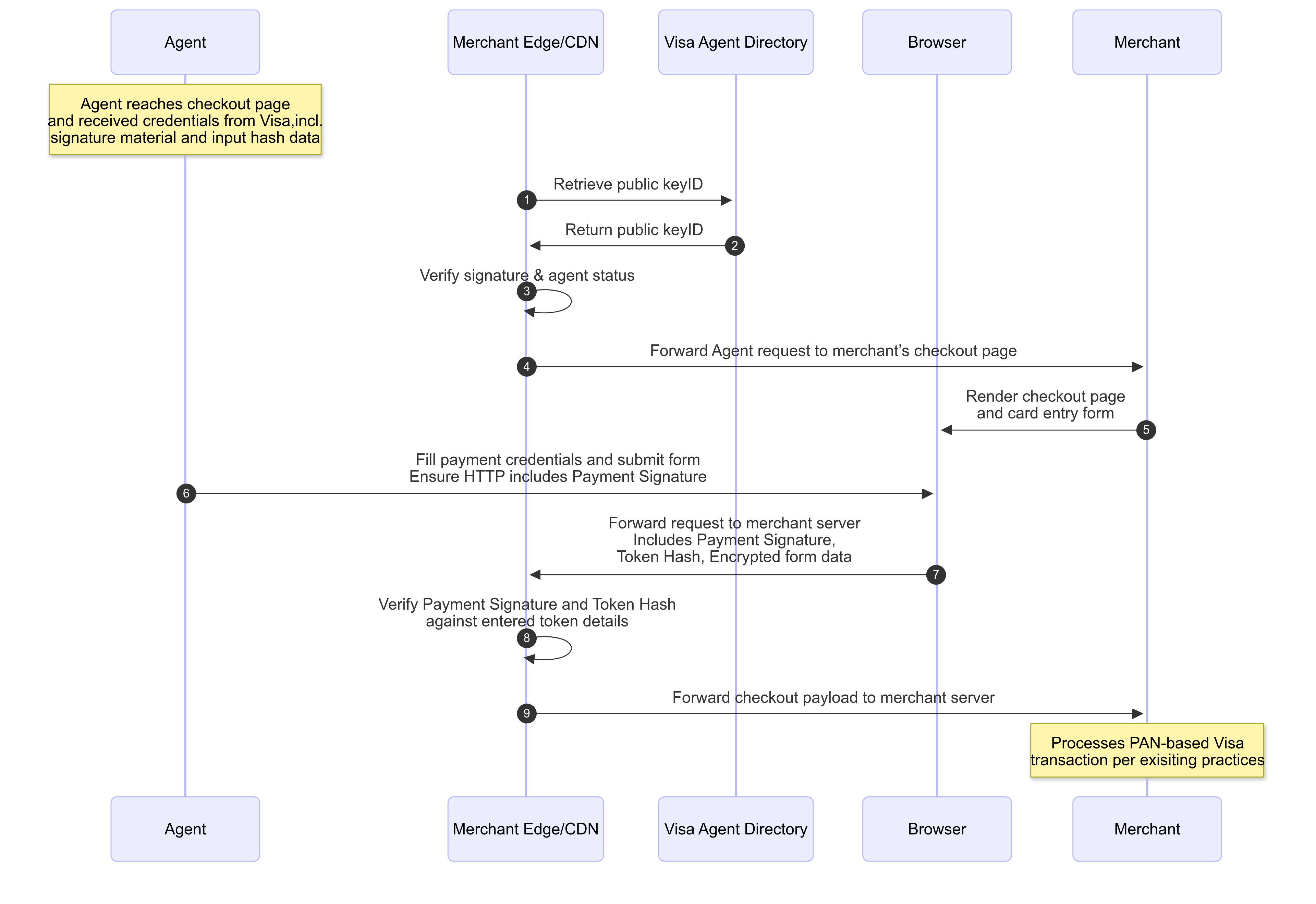
TAP attaches verifiable intent to the merchant’s existing web, API or message-protocol routes.
The specification’s /example-product and /checkout URLs are examples. TAP does not standardize a merchant product catalog, cart route, checkout method or a single 402 response body. Merchants define those contracts and validate the supplied signatures.
| Interaction | Signature tag | Data carried |
|---|---|---|
| Browsing / product detail | agent-browser-auth | HTTP message signature; consumer-recognition object may accompany it. |
| Purchase / payment | agent-payer-auth | HTTP message signature plus payment container; consumer-recognition data may also be present. |
| Pay for access | Merchant’s 402 response and paid retry | The container may carry a signed browsing IOU. Match the merchant’s invoice, amount, recipient and resource. |
Required recognition fields
GET /example-product HTTP/1.1
Host: shop.example.com
Signature-Input: sig2=("@authority" "@path");created=1793836800;expires=1793837100;keyid="YOUR_TRUSTED_KEY_ID";alg="ed25519";nonce="GENERATE_BASE64_NONCE";tag="agent-browser-auth"
Signature: sig2=:BASE64_SIGNATURE_BYTES:
Illustrative timestamps and signatures must be regenerated. The required signature-base lines quote the component names. Its final line contains the Signature-Input member value, without the sig2 dictionary label:
"@authority": shop.example.com
"@path": /example-product
"@signature-params": ("@authority" "@path");created=1793836800;expires=1793837100;keyid="YOUR_TRUSTED_KEY_ID";alg="ed25519";nonce="GENERATE_BASE64_NONCE";tag="agent-browser-auth"
Verification order
- Recognize the profile. Require the appropriate tag, fields and covered components for the interaction.
- Check time and replay. Validate the current interval and profile duration; reserve the key/nonce pair after the signature verifies.
- Resolve a trusted key. Use the Visa Agent Directory or a configured issuer, match keyid and algorithm, and reject an unusable listing or expired key when expiry is provided.
- Rebuild the exact base. Use received component order and raw signed parameters; verify the cryptographic signature. Verify content-digest when covered.
- Validate linked objects and payment. Check matching nonce / kid on consumer and payment objects, then independently verify the payment credential, merchant challenge and settlement.
Consumer recognition object
{
  "agenticConsumer": {
    "nonce": "SAME_NONCE_AS_HTTP_SIGNATURE",
    "idToken": "SIGNED_VISA_ID_TOKEN_JWT",
    "contextualData": {
      "countryCode": "US",
      "zip": "94107",
      "ipAddress": "203.0.113.10",
      "deviceData": {}
    },
    "kid": "SAME_AGENT_KEY_ID",
    "alg": "ALGORITHM_FOR_THE_SAME_KEY",
    "signature": "BASE64_OBJECT_SIGNATURE"
  }
}
The ID token’s own JWT header uses alg, kid, typ=JWT+ext.id_token; unsigned alg=none is unsupported and the prose prefers PS256 over RS256. Validate trusted issuer, audience and time claims. Public claims include iss, sub, aud, exp, iat, optional jti / auth_time / amr. Consumer claims include obfuscated phone_number / email, verified flags and optional masked phone_number_mask / email_mask. Matching to existing customers requires the merchant’s own mapping; the token does not reveal clear identities.
Agentic payment container
| Field / object | When present / purpose |
|---|---|
nonce, kid, alg, signature | Core binding/signature fields. Same signing key and matching HTTP nonce when the message signature is present. |
cardMetadata | Guest-checkout metadata: lastFour, paymentAccountReference, shortDescription and card-data display information. |
credentialHash | Guest/key-entry payment credential hash. The specification names a 16-digit number, 2-digit month/year and 3-digit security code as inputs; its exact hash encoding/algorithm is not specified here. |
payload | Merchant-public-key encrypted credential object for API/protocol checkout: token, expiry month/year, cardholderName, dynamicData, addresses and consumer contact/name fields. |
browsingIOU | Signed IOU after a 402: invoiceId, amount, cardAcceptorId, acquirerId, uri, sequenceCounter, paymentService, kid, alg, signature. Compare to the merchant’s challenge before granting access. |
Missing core fields, a mismatched nonce or an invalid payment-container signature make the data unusable for payment processing. The merchant decrypts payload using its retained private encryption key and processes the credential through its payment integration.
Sources: TAP merchant specifications, HTTP Message Signatures — RFC 9421, Visa example agent verification for payments diagram, VDP encryption overview, VDP Message-Level Encryption.