Base URLs and authentication
| API | Base URL | Authentication |
|---|---|---|
| Visa CLI lookups: keys, agents and the key list | https://auth.visacli.sh | None. Public reads, from your server |
| Visa CLI signing routes | https://auth.visacli.sh | A Visa CLI agent, OAuth or app token. They serve Visa CLI's own agents |
| VARS and VMRS, sandbox | https://sandbox.api.visa.com | Your Visa Developer project's credentials. See Authentication |
| The Visa Agent Directory, production | https://agenticdirectory.visa.com | None for reading a key by UUID |
| The Visa Agent Directory, sandbox | https://sbx.agenticdirectory.visa.com | None for reading a key by UUID |
Your first call
Most integrations start with one public lookup: the key behind a signature. It needs no account or key. This example key isn't listed, so it answers 404, which is the not-listed answer a verifier refuses. A listed key answers 200 with the agent and its keys, shown on Key lookup.
The 404 is what production returned when we ran this, trimmed to the fields to branch on.
jkt='nEArpjG3kYMcxbdzInyGlBEYQUw7RfAfe3Tw1fZvAA0'

curl -i \
  "https://auth.visacli.sh/v1/tap/registry/keys/$jkt"
const jkt = 'nEArpjG3kYMcxbdzInyGlBEYQUw7RfAfe3Tw1fZvAA0'
const url = `https://auth.visacli.sh/v1/tap/registry/keys/${encodeURIComponent(jkt)}`
const response = await fetch(url)
console.log(response.status, await response.json())import json
import urllib.error
import urllib.parse
import urllib.request
jkt = 'nEArpjG3kYMcxbdzInyGlBEYQUw7RfAfe3Tw1fZvAA0'
url = 'https://auth.visacli.sh/v1/tap/registry/keys/' + urllib.parse.quote(jkt, safe='')
try:
with urllib.request.urlopen(url, timeout=5) as response:
print(response.status, json.load(response))
except urllib.error.HTTPError as error:
print(error.code, json.load(error)){
"code": "not_found",
"detail": "tap_registry_entry",
"retryable": false,
"retry_after_seconds": null
}Find an endpoint
28 endpoints
- Public signing-key lookup
- Public agent lookup
- Web Bot Auth public-key directory
- Lease a signing session
- Sign a request from an app on your computer
- Sign a request from a hosted agent
- Register Agent
- Get Agent
- Update Agent
- List Keys
- Add Key
- Get Key
- Update Key
- Deactivate Key
- Activate Key
- Get agents by TRID
- Agents bulk onboarding
- Search keys — supplemental
- Create Merchant
- Get Merchant
- Update Merchant
- List Merchant Keys
- Create Merchant Key
- Get Merchant Key
- Update Merchant Key
- Activate Merchant Key
- Delete Merchant Key
- Public key retrieval — abstract specification
The two flows
Agent registration
Create agent + public key, active on creation
Activate and read back the key
Sign requests to merchants
Merchant integration
Register VMRS metadata as needed
Publish / activate encryption key
Verify the agent’s request signature
Validate payment and settlement
VARS is the Visa Agent Registry Service. VMRS is the Visa Merchant Registry Service. Agent signing keys establish request identity; merchant encryption keys protect delivered payment credentials. The merchant specification also supports recognition on existing sites without prescribing a VMRS registration prerequisite for every browsing interaction.
Downloads and sources
Download the public OpenAPI for the VMRS operations. It's exactly what Visa publishes.
Examples using example.com, placeholder IDs, dummy keys, tokens, signatures or fixed timestamps are illustrative. Replace those values and generate fresh signatures. Public VMRS schemas are reproduced exactly in the download; VARS schemas and the schemas Visa CLI uses are separate reference material.
External sources
Visa's published documentation:
| Source | What it covers |
|---|---|
| TAP merchant specifications | The TAP merchant specification. It links the product terms, the payment verification diagram and RFC 9421 |
| TAP getting started | Links to Visa's sample code on GitHub |
| TAP API reference, endpoint catalog | Lists 11 VARS operations marked RESTRICTED, 9 VMRS operations marked PUBLIC, and one entry with no contract, GET /v1/trustedAgentProtocol. The public OpenAPI leaves out the restricted VARS schemas |
| TAP API reference as Markdown | The same 9 public VMRS operations, with request and response fields and HTTP statuses, as in the embedded OpenAPI 3.1.0 snapshot |
| TAP product terms | The terms that accompany use of the specification |
| Example agent verification for payments | The sequence diagram linked from the specification |
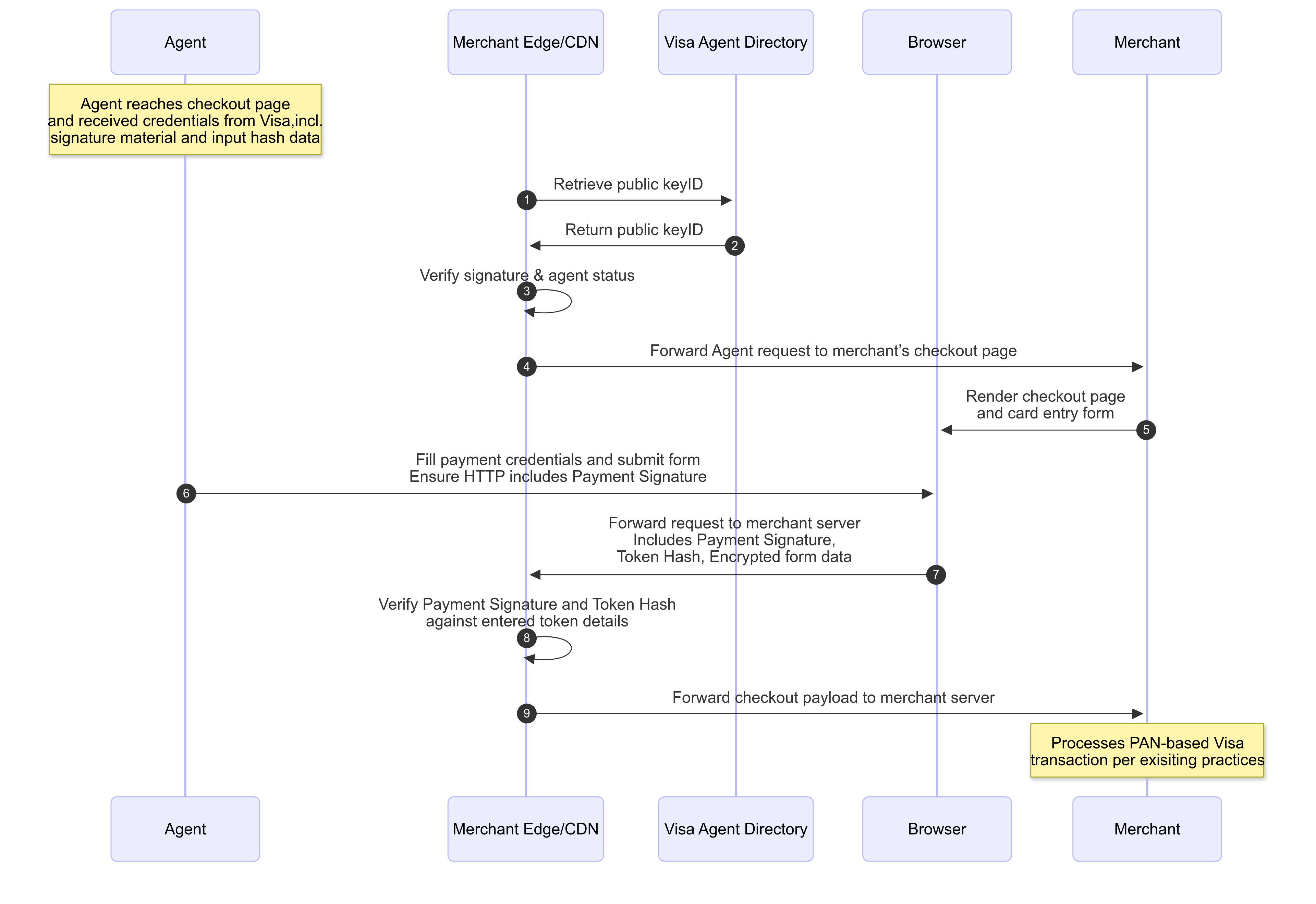
The Visa Developer Platform's general guides:
| Source | What it covers |
|---|---|
| X-Pay Token authentication | Raw request body, sorted query, context-path exclusion, API key and HMAC token formula. The generic guide spells it apikey, and VARS calls use apiKey |
| Two-Way SSL authentication | Client certificate plus HTTP Basic authentication. Keep this transport separate from TAP request signatures |
| Authentication overview | Product and project configuration selects authentication |
| Quick start | Account, project, selected APIs and environment-specific credentials |
| Encryption overview | Read it alongside the VMRS encryption-key fields |
| Message-Level Encryption | A related platform encryption guide. Its MLE keyId is a separate integration concept |
| Request and response codes | General platform conventions. Endpoint-specific statuses on these pages come from the relevant operation contract |
| Error codes | Platform error guidance, not a complete endpoint-specific response schema |
| Environment switching and testing | Sandbox, Certification and Production use separate settings and credentials |
| Going live | Commercial onboarding and next-environment access are distinct from creating a VARS or VMRS record |
| Working with Visa APIs | Supporting context on request flow and environments |
| Release notes | We found no additional TAP, VARS or VMRS endpoint contracts here |
| Certificate signing request guide | Certificate setup, linked from the mTLS and encryption guides |
| Trusted certifying authorities | Certificate authorities, linked from the mTLS guide |
| Outbound callback configuration | A related authentication and encryption guide. We found no TAP-specific callback endpoint contract here |
The standard behind the signatures:
| Source | What it covers |
|---|---|
| HTTP Message Signatures, RFC 9421 | Signature-base construction and the Signature and Signature-Input definitions. It settles formatting differences in examples |
Visa's sample implementation on GitHub. Where a sample's README and its route definitions differ, the route definitions take precedence.
| Source | What it covers |
|---|---|
| Root README | The sample as a whole |
| Agent Registry README | The sample's Agent Registry component |
| Merchant Backend README | The sample's merchant backend |
| CDN Proxy README | The sample's CDN proxy |
| Merchant Frontend README | The sample's merchant frontend |
| TAP Agent README | The sample's TAP Agent |
| Agent Registry routes | Route definitions |
| Agent Registry schemas | Schemas |
| Merchant router mounting | How merchant routes are mounted |
| Product routes | Route definitions |
| Cart routes | Route definitions |
| Order routes | Route definitions |
| Signature-verification routes | Route definitions |
| Merchant schemas | Schemas |
| CDN proxy routes | Route definitions |
| Payment-flow diagram | Image linked from the root README |
| TAP Agent screenshot | Image linked from the TAP Agent README |
| Merchant screenshot | Image linked from the Merchant Frontend README |


